Introduction

What does a teacher really contribute to learning? ➤


Is it not the student's responsibility to inspire and motivate himself? The teacher leads by example, establishes trust (partly by easing the fear of failure), presents to students interesting or desired topics or skills, and provides instruction and assessment (that hopefully doesn't punish). The rest is up to the student. Or is it? Is successful teaching only measurable by the extent to which a student is somehow induced to learn?

What teachers often share with each other is the craft of teaching; the employment of techniques and the solution to problems. Teachers rarely discuss what teaching itself actually is. It is like asking a fish what swimming is: "I don't know, I just do it."

There is such a thing as teaching. ➤


Teaching is not coaching, though it can include coaching. Teaching is not training, though training can be a part of teaching. Teaching is not just explaining, not just instructing, it is not supervising, it is not facilitating, not babysitting, not managing, not providing services, not delivering curriculum, not simply and somehow the inverse of learning. It is its own activity, its own expertise, an expertise that happens to have student learning as an end goal.

Why define teaching? ➤


If teachers don't define teaching for themselves, others will, and quite likely to the detriment of teachers. The problem is that the "wrong" definition of teaching can harm and interfere with a teacher's ability to really teach. What is a "wrong" description of teaching? Here are just a few examples: babysitting, coaching, facilitating, managing, providing services, delivering curriculum, the inverse of learning. Why are these descriptions wrong? Because the focus is either on behavior control or delivery of instruction, but not at all on what can be described as engagement.

There are two problems. Delivery of instruction includes designing instructional materials and designing tests. Both of these activities can be done on a corporate or academic level by experts, with an eye toward monopolizing, automating, and monetizing such activity. Teachers are just expected to deliver the canned curriculum to students. And much of what could be thought of as engagement is instead thought of as classroom management, often resulting in, at worst, moralistic or belittling approaches to control and discipline. Behavior modification approaches are an improvement, but best would be a sociological approach to adjusting student behavior, directly and indirectly, in the service of engagement.

Teachers need to engage to be effective. The key to this is understanding how a teacher's stagecraft and presence can help students interact with instructional materials. While discipline first, instruction second is a common recipe, it results unfortunately in poor outcomes. Instructional materials cannot teach themselves. Without an engaging teacher, any student is simply self-taught, for better or worse.


About MeMy ApproachMy ProjectsAbout TeachingContact Me

David Labaree - Targeting Teachers

David Labaree is a historian and retired Professor of Education at the Stanford Graduate School of Education. This essay is taken from his website (https://davidlabaree.com/).

He introduces the essay thus: ➤

In this piece, I explore a major problem I have with recent educational policy discourse — the way we have turned teachers from the heroes of the public school story to its villains. If students are failing, we now hear, it is the fault of teachers. This targeting of teachers employs a new form of educational firepower, value-added measures. I show how this measure misses the mark by profoundly misunderstanding the nature of teaching as a professional practice, which has the following core characteristics:

  • Teaching is hard
    • Teachers depend on their students for their professional success
    • Students are conscripts in the classroom
    • Teachers need to develop a complex teacher persona in order to manage their relationship with students
    • Teachers need to carry out their practice under conditions of high uncertainty
  • Teaching looks easy
    • It looks like an extension of child raising
    • It is widely familiar to anyone who has been a student
    • The knowledge and skills that teachers teach are ones that most competent adults have
    • Unlike any other professionals, teachers give away their expertise instead of renting it to the client, so success means your students no longer need you
  • Teachers are an easy target
    • Teachers are too visible to be inscrutable and too numerous to be elite
    • They don’t have the distance, obscurity, and selectivity of the high professions — so no one is willing to bow to their authority or yield to their expertise

Here's the link to the complete essay on his website: https://davidlabaree.com/2024/07/04/targeting-teachers-3/

Here's the link to the original publication in Dissent, 2011: https://drive.google.com/open?id=1RvOPUrxd9UKMJGDPLB7UY5ZFlzrUmsHf

Posts

Should Teachers Know the Basic Science of How Children Learn?

This quotation is from an article published by the American Federation of Teachers (AFT) in the summer of 2019, part of a series called "Ask the Cognitive Scientist." The scientist is Daniel T. Willingham, a cognitive scientist dedicated to passing on and explaining the results of cognitive research to school teachers.

(Willingham's website is a treasure trove of useful science. In particular, click on his articles.)

Scientific knowledge can influence educational practice in more than one way. Sometimes the applications are overt, as when scientific descriptions of how children learn offer new ideas for instructional methods. For example, researchers have described the learning benefits of spacing out practice1 and some educators have sought to incorporate that finding into their classrooms.
Science can also influence education through the use of scientific methods to evaluate the effectiveness of different educational practices. Scientists have a lot of experience designing experiments and can offer useful techniques to help decide whether, for example, two reading programs differ in how much they motivate children to read independently.
*   *   *
An educator’s practice is, of course, influenced by her beliefs about what children are like. Teachers try to tune their practice to what they believe to be children’s nature, in the perfectly reasonable belief that teaching will be more successful if it accounts for the way children learn. These beliefs influence not only planning but also teachers’ in-the-moment reactions and responses when something unexpected happens in the classroom. Furthermore, beliefs influence our receptiveness to new ideas.2 When a vendor offers a new product, for example, or an administrator suggests a new classroom practice, teachers evaluate it in light of their beliefs about children.
Scientific findings provide one (but obviously not the only) source of information contributing to educators’ beliefs about the nature of children. . . . Here I want to make a different point: some statements concerning children’s learning are perfectly sound scientifically but should not influence educational decisions. That includes some statements that seem like they ought to have a direct bearing on classrooms.
1. N. Cepeda et al., “Distributed Practice in Verbal Recall Tasks: A Review and Quantitative Synthesis,” Psychological Bulletin 132, no. 3 (2006): 354–380.
2. R. Nickerson, “Confirmation Bias: A Ubiquitous Phenomenon in Many Guises,” Review of General Psychology 2, no. 2 (1998): 175–220.

The article goes on to address the sometimes confusing intersection of cognitive science and teaching, the difference between empirical generalizations and theoretical statements in science, and why teachers should focus on empirical generalizations for application to their teaching.

If you would like examples of empirical generalizations, there is a table of articles by Willingham focusing on specific generalizations - click here.

In addition to the article, there is also a huge AFT sidebar packed with useful information and a lot of links to other resources. Here's a blog post of mine about one of those resources.

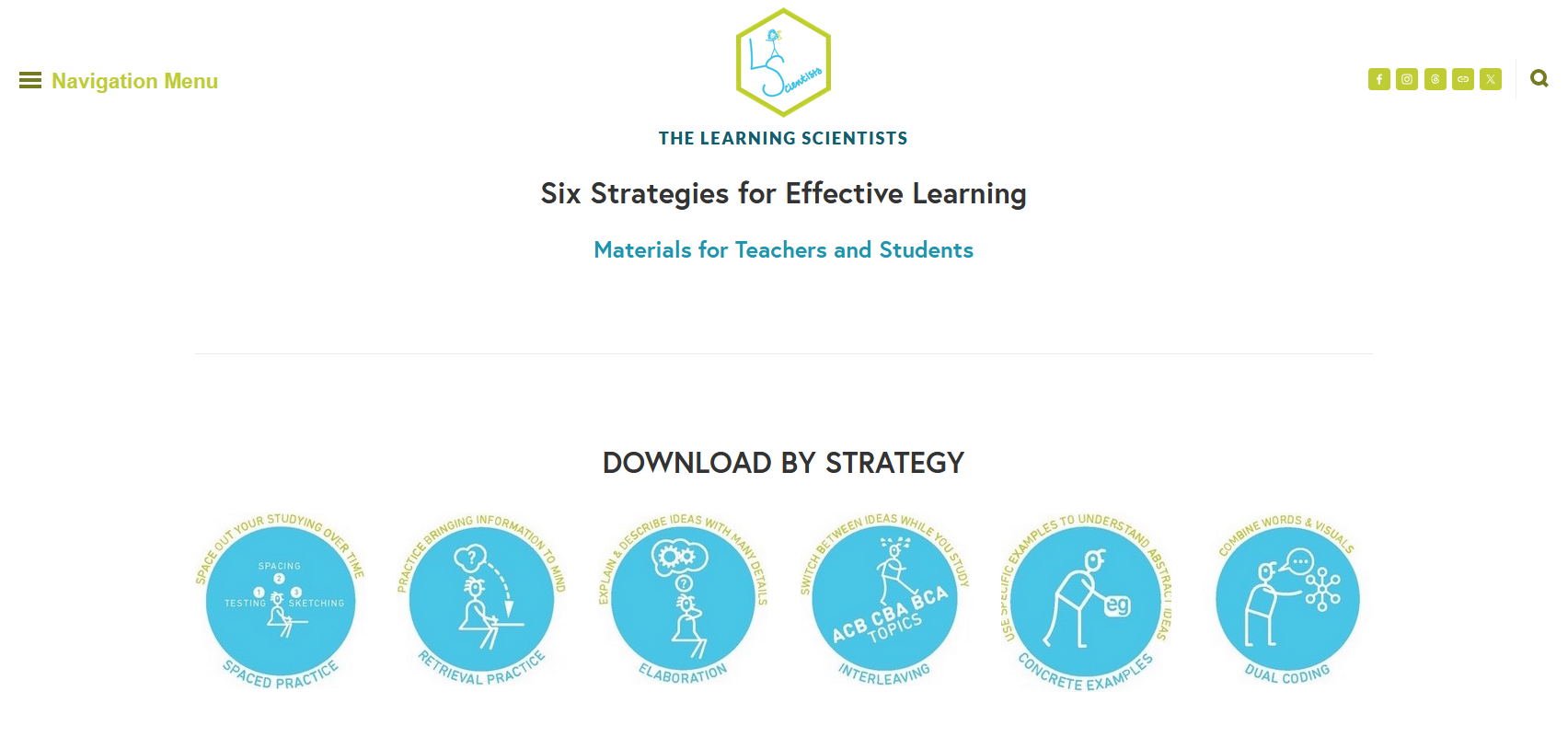
The Learning Scientists

Here's a recommendation: in an earlier posting, (Should Teachers Know the Basic Science of How Children Learn?), I mentioned the American Federation of Teachers, who publish the "Ask the Cognitive Scientist" series.

Among the multitude of other resources available on their site is a website called The Learning Scientists.org. The AFT describes it as "a website written by four cognitive psychologists interested in education." The Learning Scientists describe themselves as "Making scientific research on learning more accessible to students, teachers, and other educators." Yes, there are four main writers, but quite a collection of collaborators and scientists as well.

This is a very up-to-date, diverse, accessible site worth visiting and exploring if you are a teacher interested in cognitive science.

Which you should be. Honest. Give it a look.